What Threads of the Triad Means to Me
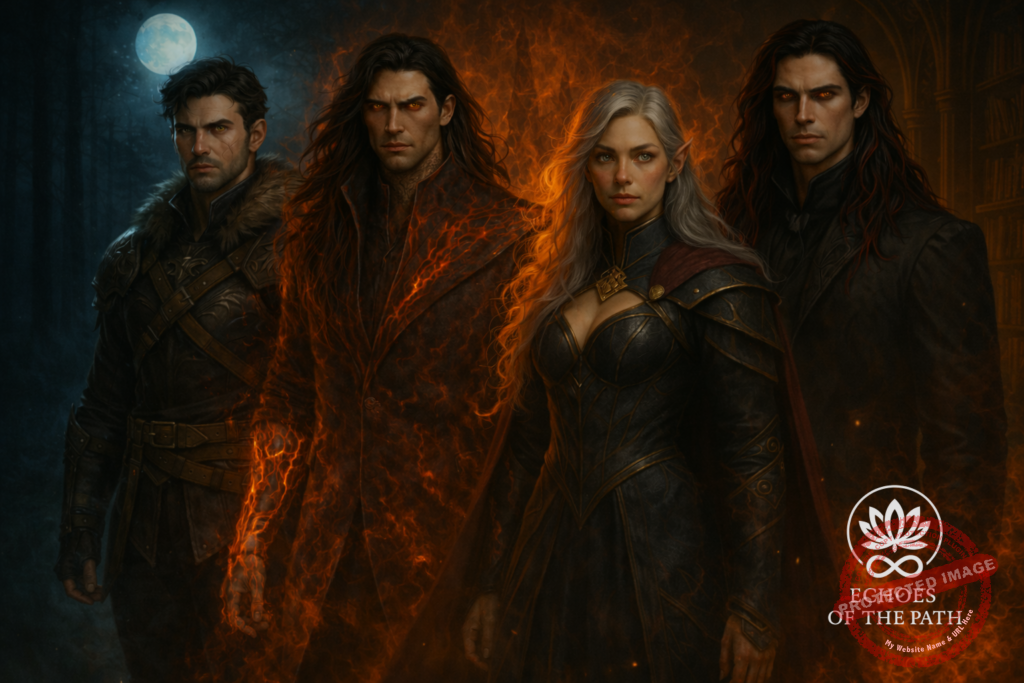
When I look at the relationship between Aistriana, Keros, Aedric, and Vharon, I don’t see a romance structure.
Seeing a Map, Not a Romance
Instead, I see a map.
This story did not begin as a plan. Instead, it began as a way to stay alive long enough to understand myself. Writing these characters was never about fantasy fulfillment. It focused on recognizing patterns, how I survived, how I protected myself, and how I learned, slowly, to stop living only in reaction to pain.
Aistriana: Endurance
Aistriana carries the center of that map.
In this way, she represents the part of me that learned endurance early. She survived by becoming functional, responsible, capable. Similarly, I learned how to keep going even when grief stayed unresolved, even when silence felt safer than hope. She does not embody strength without cost. She forges strength because no other option remains.
However, endurance alone is not living.
Keros: Restraint
At the same time, Keros exists where protection meets restraint. He embodies the part of me that learned how dangerous unchecked force can be, whether that force expresses itself as anger, desire, or intensity. In contrast, Keros is not about domination or control. He represents slow, painful understanding: power must learn when not to act. Staying present without hurting what you love requires skill, not instinct.
Aedric: Memory
Aedric carries memory.
He is the part of me that remembers everything, every consequence, every loss, every choice that could not be undone. As a result, he exists in the tension between knowing and reliving, between truth and survival. Through him, I explored the fear of seeing truly, seen not as I pretended to be, but as I actually was beneath all the careful masks.
Vharon: Refusal
And then there is Vharon.
Ultimately, Vharon is refusal.
He represents the moment I learned that walking away can be an act of protection, not failure. Because of this, that refusing a path, even one you once shaped, can become the only way to avoid becoming something you never wanted to be. Vharon carries the fear that love, like power, might bind rather than free. And he carries the harder question: whether denying yourself connection is truly safer than risking transformation.
Writing as Listening, Not Escape
These four characters are not fragments of a single relationship.
They are fragments of a process.
Together, they form a system of balance I did not have at the beginning: endurance without self-erasure, strength without harm, memory without paralysis, refusal without isolation. Through this process, writing their connection allowed me to explore what a relationship could look like when it is not built on saving, fixing, or escaping, but on choice, presence, and responsibility.
The triad bond is not about excess.
It is about integration.
Ultimately, it asks a simple but terrifying question:
What happens when all the ways you learned to survive are asked to coexist, instead of competing?
What Threads of the Triad Means to Me
For me, then, the answer became the story.
Not a promise of perfection.
But a quiet return to life, one where connection does not erase pain, but makes room to carry it differently.
That is what these characters mean to me.
They are not who I was.
They are how I learned to keep going.
Blog Categories*
*This blog extends ideas from the novels, reflections, process writing, and lived experience behind the stories.
Leave a Reply