I am sharing this text exactly as it was generated by my mind. You will notice a structure that deviates from standard writing; I could have polished it to perfection, but that would mean hiding the very ‘glitch’ I am writing about. This is my raw, unedited reality, not a lack of ability, but a choice to value truth over a clinical mask.
Mapping the Unseen
Every child with dyslexia needs a path built just for them, a personalized map through the world of letters and sounds. But sometimes, when the weight of that responsibility feels heavy, a certain furry supervisor steps in.
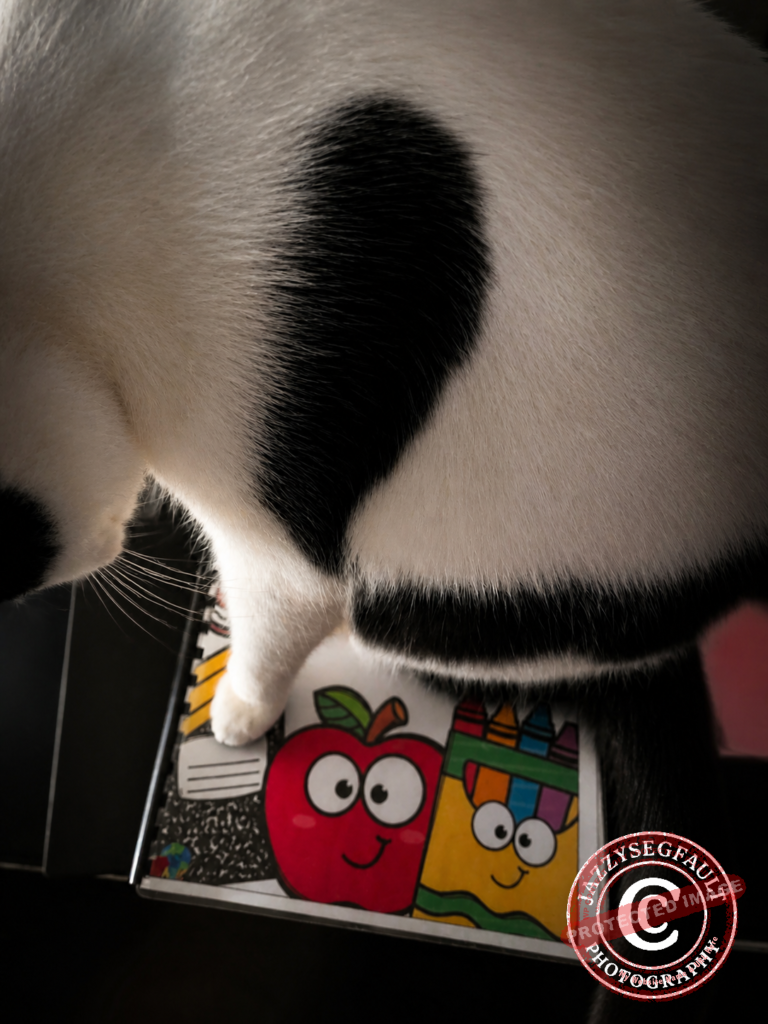
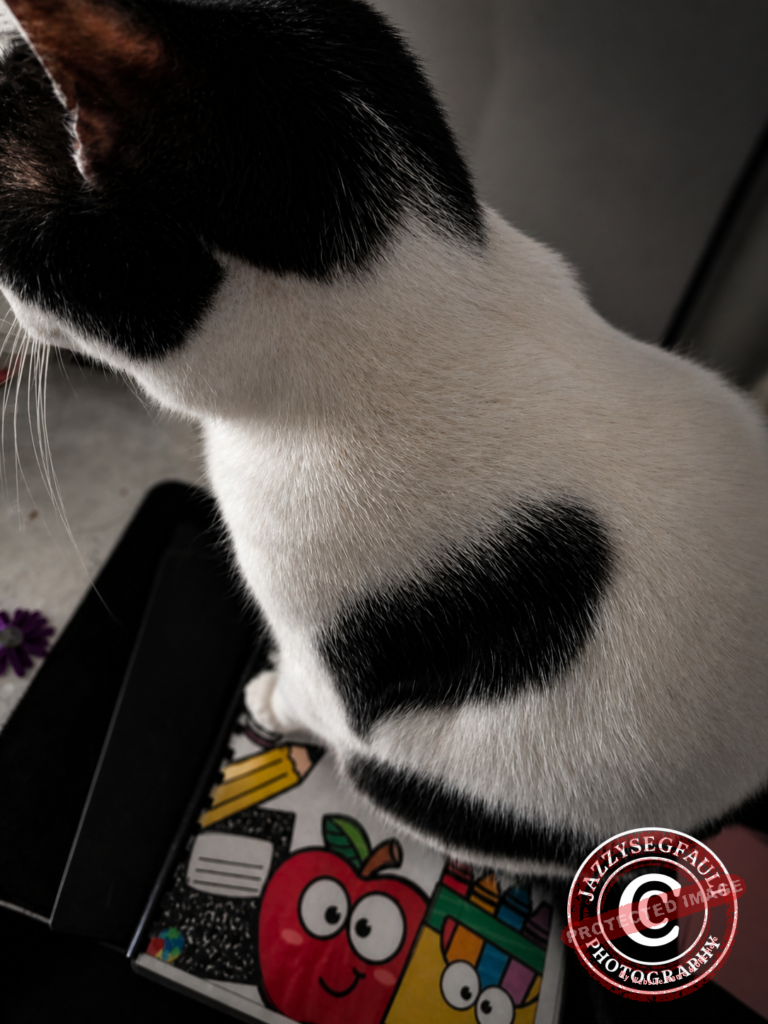
My cat Puffy decided that this specific notebook is the best place to demand forehead kisses. It’s his way of reminding me to just sit in the quiet and breathe. Apparently, this is his version of “professional support.”
More Than Just a Difference
Dyslexia is not merely a different way of being; it is a genetic “refraction” that leaves many with a profound lack of understanding. People often fail to grasp that we don’t just think differently, we think in images rather than words. It’s a flood of simultaneous thoughts that refuse to line up in a neat, chronological order. For someone like me, information isn’t a luxury; it’s an existential necessity for processing and assimilation.
The Anatomy of an Island
If I have this visceral need to know how a needle is made, then I need to know where it came from, and why it exists. Without every granular detail, I cannot retain the information. Trying to learn through rote repetition is like trying to summon a demon that doesn’t understand your incantation. My mind simply refuses to be “typical” or to follow the well-trodden paths of others.
The Sensory Paradox
Also my hearing is a glitch of its own. It is so sharp that I often wish I didn’t know what the neighbours are discussing in the hallway. I truly don’t need to know why they didn’t make it to the grocery store today.
My sense of smell follows the same erratic rules, and honestly, it might be the hardest one to live with. I can detect that a dish has started to turn long before anyone else even picks up a scent. Most perfumes don’t smell like flowers to me; they feel like they are literally stealing my oxygen, leaving me suffocated. Certain foods trigger an instant wave of nausea before I even see them, my nose has already decided the battle is lost.
My vision follows the same erratic rules. I can’t read a sentence/paragraph like a “normal” person does, but I can see microscopic details that others miss. My partner often hands me IT components, asking me to read serial numbers etched so small they look like dust to the naked eye. I can see those tiny, needle-tip letters with perfect clarity.
Yet, when I try to read a simple page, my brain betrays me. Words like “horse” and “house” become indistinguishable. My mind can track a microscopic “1” from a “7” on a circuit board, but when it faces a sentence, it just shrugs and asks: “They sound similar enough, so why does it matter?”
The Clinical “Glitch” Behind the Senses:
- Olfactory Hypersensitivity: In dyslexia, sensory pathways are often more “open.” Smell is the only sense that hits the limbic system directly, the brain’s emotional and survival center. This turns a bad scent into a physical threat (nausea, suffocation), not just a nuisance.
- The Survival Scan: Detecting spoiled food or distant sounds is an ancestral survival mechanism. My brain “scans” for environmental threats far more efficiently than a typical one.
- The Detail vs. Whole Paradox: This is the signature of my mind. My eyes are high-precision microscopes for technical details, but my brain refuses to act as a linear word processor, it has his only unique autocorrect.
The Marathon of the Spoken Word
Don’t get my started on reading aloud feels like running a marathon without a finish line. If I don’t track the upcoming words with surgical precision, I run out of breath. I have to consciously dose my words with every inhalation and exhalation, navigating periods and commas like hurdles. Sometimes, the physical strain leads to headaches. I’ve literally had to learn how to hold my breath just to finish a sentence.
Breaking the Cycle for the Next Generation
As I look at the children I work with, I wonder: What if I could break these barriers for them now? I want to offer them an alternative so they don’t have to reach adulthood to find the structures I had to fight for. I want them to skip the exhaustion I endured.
This is why I create a unique, proprietary system for every single child. It is immense work, but it is worth every second. No two dyslexics are the same: one might lose sounds, another flips letters, while another replaces entire words. I am doing for them what someone once did for me years ago: I am offering a chance to be seen, understood, and finally, to breathe.
A Personal “Glitch” Note: If you noticed my punctuation is a bit… unconventional, there is a reason. To me, punctuation marks are my greatest enemies when I read. A long sentence is like a double-edged knife. Every time I try to handle one, I end up cutting my fingers because it’s just too heavy to carry. So, if the text feels short and sharp, it’s because I’m just trying to make sure we both get to the end of the page without needing a bandage.
One last confession for the road: Writing is where the real war happens. My brain doesn’t just offer one sentence; it offers three, four, or five versions at the exact same time. Writing feels like I’m forced to kill off four beautiful ideas just so one can survive on the page. And because I’m terrified that a single pause will make me lose the thread, I just run. I end up with a ten-line sentence that looks like a minefield of commas and only one lonely period at the very end. It’s like a tactical sweep after the battle is over, searching for a place to put a sign of life. And as for those long dashes? I run from them like they’re a swarm of angry bees, because, honestly, half the time I have no idea where they are supposed to go. To me, a long dash is just a visual trap, a flatline in the middle of a sentence that makes my brain panic and ask if the story just died.
More Than a Diagnosis: Redefining My Own Reality
I have been accused of using my dyslexia to market my books. But what I am actually doing is trying to show that if you are dyslexic, you can write if that is your desire. You can become a psychologist, even when it feels difficult, even if it requires working harder than everyone else. I have worked various jobs before becoming a psychologist and an author, and I’ve taken something from each of them to fuel what I do today.
I am not using my dyslexia for profit; I am using my own diagnosis to prove that it is possible. My mind is always full, with thoughts that often overlap, and while I have learned how to organize them so I don’t overload my system, that is why I have embraced the term “glitch.” From my point of view, when my mind is flooded with information, it tends to reach that point of a “segfault” error. So, I decided to be that glitch in the normalcy of the world. I accept my neurodivergence, but I don’t want to be considered “atypical.” In psychology, we use the terms “typical” and “atypical,” but as a human being, it hurts to be called atypical. I chose my own label, “glitch”, because I need power over who I am. It is difficult for me to accept being labeled as atypical.
To others, “glitch” might mean an error, but for me, it is a reclamation of my identity. I want to be more than just a diagnosis on a long list of disorders in the DSM. I want to be me, with my highs and lows, my successes and failures; driven by the desire to do what I love, even if it is hard and requires double the effort of “typical” people.
I want to show through my work that you can achieve what you want, even if it is difficult at the beginning. If you want to be a psychologist, an author, an astronaut, a doctor, or anything else, you can. Once our minds receive information, they can find over 20 or 30 solutions in a very short time and choose the one that is best based on the data.
To me, dyslexia is not an anomaly; I see it as a genetic evolution that gives us the chance to find a path that is different, unique, and often better. My deepest wish is that for those who come after me, by the time I take my last breath, they have a better chance than I did. I want a world where being dyslexic, autistic, or otherwise neurodivergent is seen as a bonus; where everyone finds their place. I want them to feel that they can do what they’ve always dreamed of doing. It is harder, yes, but that does not mean it is impossible.
Leave a Reply