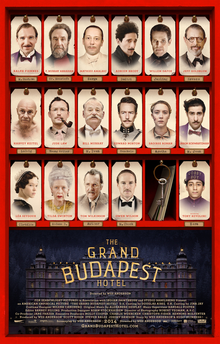
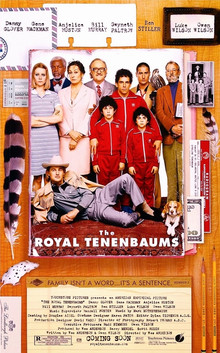
Today’s film: The Grand Budapest Hotel (2014) & The Royal Tenenbaums (2001)

3rd time watching / 3rd time watching

THE FILM MIND: The Architecture of the Authentic Misfit

For me, Wes Anderson doesn’t just make movies; he builds “sanctuaries for the unadapted.” Watching The Grand Budapest Hotel and The Royal Tenenbaums for the third time, I see a specific aesthetic of rigidity that hides extreme vulnerability. I identify with these characters, they are “cringe,” they are obsessive, and they flat-out refuse to dilute themselves just to please the world.

1. Resistance Through Etiquette (The Grand Budapest Hotel) I see M. Gustave as the prototype of a man who refuses to let a brutal reality ruin his “vibe.”

  • The Polished Armor: In a world collapsing into fascism, he remains impeccably perfumed and polite. I don’t see this as snobbery; it’s a survival mechanism. He maintains a rigid structure (the hotel) so he won’t be swallowed by the external chaos. It’s the authenticity of someone who has decided that “manners” are the only form of dignity left. When the external environment becomes chaotic, he creates an ultra-structured micro-universe to preserve the integrity of his Ego.

2. Trauma as a Uniform (The Royal Tenenbaums) In this film, the inability to adapt is a family inheritance. I view the Tenenbaums as a clinical study of “genius children” who failed to become functional adults.

  • The Costume of Grief: Every character has worn the same “uniform” (the red tracksuit, the headband, the fur coat) for decades. To me, this visual rigidity reflects an emotional freeze-response. They are “special” because they don’t know how to communicate except through these archaic roles, refusing to change in a world that disappointed them. They refuse to “grow up” in a world that doesn’t offer them the safety of their childhood, choosing instead an unadapted form of authenticity.

3. Conclusion: The Beauty of Being Rigid Anderson teaches me that being “unadapted” isn’t a defect. It’s having an operating system refuses to be squeezed into a standard mold. These characters are rigid because their integrity depends on those boundaries.
A Personal Reflection: The Dyslexic Loop and the Little Reset Button

If Wes Anderson ever made a movie about a psychologist analyzing movies, he’d probably look at my kitchen table discussions and think: “Too much chaos, where is the symmetry?”

Recently, I found myself locked in a debate with my 15-year-old son. We are both “equipped” with that specific dyslexic logic: we can discuss five different subjects simultaneously (from geopolitics to the consistency of coffee foam) and somehow return exactly to the main point after 40 minutes. It’s a form of “mental parkour” where we hold our ground with a rigidity worthy of a Royal Tenenbaum.

My partner intervenes every now and then, trying to “reset” the system before our circuits fry, but our true “restart button” is my youngest son, the 11-year-old. He sits there, observes us spinning in logical circles, and then drops a short, three-word sentence that just gives us both a “Blue Screen.”

In that moment, my eldest and I stop, look at each other, and start dismantling everything we’ve built up to that point, re-analyzing the entire mess from the little one’s perspective. We’re like a bomb squad that just realized we were cutting the wrong wires.

The reality is, we are a family of authentic misfits. We debate until our ideas look like a Picasso painting; all the elements are there, but nothing is where you’d expect it to be. We circle back because our logic isn’t a straight line; it’s a spiral. We always return to the starting point, but with less battery and more questions.

I guess that’s why I identify with Anderson’s characters. I am rigid in my way of thinking, I am probably “cringe” to an outside observer who wants a linear conversation, but I am extremely human in my attempt not to dilute my logic just to appear “normal.”

At the end of the day, I am not a perfectly organized “Grand Budapest Hotel.” I am more like a living room full of “Tenenbaums” arguing with enthusiasm, until someone smaller reminds me that sometimes, the shortest distance between two points is the one I completely ignored because I was too busy analyzing the texture of the grass on the sidelines.

Blog Categories*

Behind the Scenes

Personal Notes

The Film Mind

Explore the archive

*This blog extends ideas from the novels, reflections, process writing, and lived experience behind the stories.

Comments

Leave a Reply

Your email address will not be published. Required fields are marked *