Transparency After Fire
Ashspire does not pretend it was unharmed.
After the Demon War, its leylines were severed, not as punishment, but as a recognition of reality. Too much power had moved too freely. Too much damage had passed through unseen corridors. Reopening those paths without restraint would not have restored balance.
It would have repeated the rupture.
So Ashspire returned differently.
One Gate, Not Many
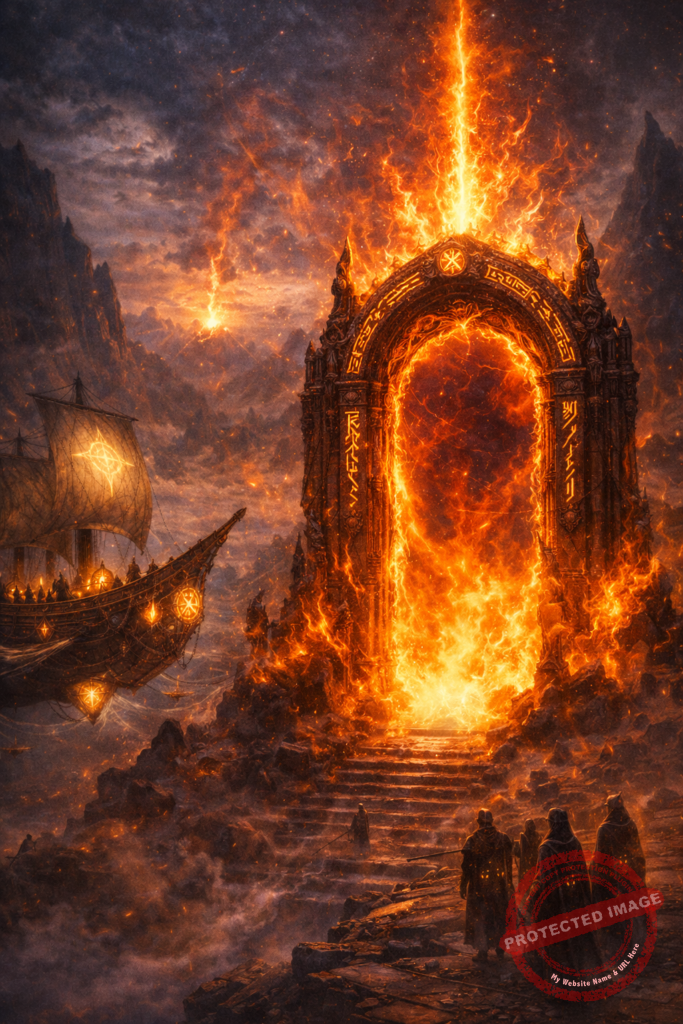
The Embergate is the only sanctioned point of entry into Ashspire.
Not hidden.
Not secret.
Not flexible.
Every passage goes through the same place. Every arrival is witnessed. Every departure leaves a record.
This is not efficiency.
It is accountability.
When devastation has already occurred, openness is no longer optional. You don’t scatter entrances. You don’t allow quiet movement. You choose a single threshold and you make it visible enough that no one can pretend not to see what passes through it.
Fire That Does Not Hide
The Embergate does not open silently.
When activated, it sends a flare across the Aether, a signal visible to all major skyports and permanently recorded in the Council’s Observatory. The flare includes who activated it, who passed through, and why.
Fire, here, is not destructive.
It is declarative.
This is fire that says: I am here. I am moving. I am accountable for the consequences.
Returning Is Not the Same as Being Forgiven
Ashspire was allowed to reintegrate, but not unchecked.
Only one skyship may dock.
Only one gate may open.
Every action is logged.
This is not trust restored.
It is trust rebuilt slowly.
I understood this kind of return outside of fiction as well.
Returning to systems after burnout, trauma, or deep rupture doesn’t happen through declarations of wellness. It happens through supervision. Documentation. Ethical oversight. Through agreeing to be seen again before being believed again.
That process can feel humiliating if you mistake visibility for judgment.
But visibility can also be protective.
When Oversight Is a Gift
Supervision exists not because you are untrustworthy, but because the cost of failure is too high to carry alone.
In clinical work.
In education.
In caregiving roles.
I learned that accountability does not mean erasing your capacity for harm. It means acknowledging it, and building structures that prevent it from going unchecked.
Ashspire doesn’t deny its fire.
It contains it.
Choosing to Be Seen
The Embergate represents a moment most systems struggle with: allowing someone who has caused damage, or been damaged, to re-enter without pretending nothing happened.
It requires restraint from both sides.
From the one returning, it requires humility.
From the system, it requires courage.
Because monitoring is not the same as control.
It is a shared agreement that safety matters more than pride.
What the Fire Taught Me
I didn’t stop being dangerous.
I learned to be accountable.
This form of movement is not freedom in the romantic sense. It is freedom that accepts consequence. Freedom that agrees to be logged, reviewed, questioned.
Ashspire does not ask to be trusted blindly.
It asks to be watched.
And sometimes, that is the most honest form of reintegration there is.
Blog Categories*
*This blog extends ideas from the novels, reflections, process writing, and lived experience behind the stories.
Leave a Reply