Blog

  • When Stillness Became Unsafe

    There was a time when staying still felt like survival.

    In earlier books, I built rules. Borders. Systems. Characters.
    They weren’t there to control the world; they were there to hold it together. To keep parts of it from bleeding into one another until I could breathe again.

    But Book Three exists because it stopped being enough.

    This book was written in my third year of therapy, a year when naming things was no longer the hard part. By then, I had language. Insight. Awareness. What I didn’t yet have was movement that wasn’t driven by urgency or collapse.

    I had learned how to endure.
    I had not yet learned how to choose.

    When the Past Shifted Shape

    The diagnosis of dyslexia didn’t fix anything.
    It reframed everything.

    It happened quietly.

    My psychologist had asked me to keep a journal. I did, but I wrote stories instead.

    Two books, written as narrative because that was the only way my thoughts would hold together without fragmenting. I brought them into therapy not as literature, but as evidence, a way of showing what I couldn’t explain directly.

    She read them carefully.

    Not for plot.
    For structure.

    And then she said something that stopped time for a moment:
    “You know this reads like someone who has been compensating their entire life.”

    The diagnosis didn’t arrive as a revelation.
    It arrived as recognition.

    The Cost of Constant Translation

    Suddenly, the effort made sense.
    Not effort as discipline or ambition, but effort as constant translation.
    The invisible work of holding thoughts in place long enough to shape them.
    The vigilance required to keep meaning from slipping through cracks no one else seemed to notice.

    The exhaustion, too, took form.
    Not the kind that comes from doing too much, but from doing everything twice: once to understand it internally, and once again to make it legible to the world.
    The way staying in place always felt like swimming upstream, not because I lacked strength, but because the current was never designed for how my mind moved.

    Endurance had never felt neutral.
    It always carried a price.

    From Moral Failure to Evidence

    What I had mistaken for resilience was often compensation.
    What I had called discipline was frequently survival strategy.
    Overpreparing. Overchecking. Rereading until words blurred.
    Building systems around myself without realizing I was doing so, just to stay afloat in spaces that assumed ease where there was none.

    Nothing about who I was changed.
    My capacity didn’t suddenly improve.
    I didn’t become “better” at anything.

    But the past reorganized itself.

    Moments I had filed away as personal failures loosened their grip.
    The chronic tension around tasks others found simple.
    The shame of needing more time, more structure, more silence.
    The instinct to endure quietly, even while asking careful, persistent questions to understand what I didn’t yet have language for.

    They stopped being moral flaws.
    They became evidence.

    Not of weakness, but of adaptation.
    Of a mind that had learned to move sideways when forward was blocked.
    Of a system built not for comfort, but for survival.

    And once seen, it could no longer be unseen.

    Containment Was No Longer Enough

    By the time I was writing Book Three, containment had done its job.

    In Book Two, containment was the work.
    Boundaries. Agreements. Rules that prevented collapse. A system where pain could exist without consuming everything. But containment has a limit.

    There comes a point when the rules I built to survive begin to restrict my ability to grow. When staying within them requires more energy than moving beyond them. When endurance turns into erosion.

    That was the year I was living in.

    In my second year of nursing college, I made the decision to pursue psychology and enroll the following year.

    During my clinical placements as a nurse in a children’s hospital, especially in orthopedics and surgery, I learned that pain does not wait for you to be ready. I often stayed beyond my required hours, unable to step back into my own life while children continued to suffer.
    Skill alone was never what I wanted to offer patients.
    What I wanted was to understand them.

    That is why I enrolled in a psychology program. Understanding meant learning how to move toward people, not only away from my own limits, and I could no longer do that by staying still.

    Movement, Not Escape

    Transportation systems in this world are not conveniences.
    They are not shortcuts.
    Nor are they about running away.
    They exist because movement became necessary.

    This book was written in a year where motion stopped being reactive. Where I learned that leaving a place: emotionally, cognitively, structurally, doesn’t mean abandoning it. It means acknowledging that what once protected you may no longer be safe.

    Movement became intentional.

    That’s why every form of transportation in this world has rules. Costs. Permissions. Limits. Witnesses.

    Not because motion should be controlled, but because it should be chosen.

    Why Transportation Exists at All

    Rules taught me how to stay.
    Movement taught me how to choose.

    I had built transportation systems when I accepted that not all growth happens in place, when I understood that endurance by itself is not a virtue, and when I realized that sometimes the most responsible thing you can do is admit that where you are: mentally, emotionally, structurally; is no longer safe.

    These systems are not about speed.
    They are about agency.

    Some paths require clarity before you can take them.
    Others require permission.
    Still others demand witnesses.
    Many take time.
    A few refuse to be rushed.

    And some only open when you stop mistaking stillness for strength.

    Setting the Journey

    This series of posts is not just about how characters move between realms.

    It’s about how I learned to move between parts of myself without erasing any of them.

    Book Three begins when containment breaks its silence and asks a harder question:

    If you can move, how will you choose to do it?

    Blog Categories*

    Behind the Scenes

    Personal Notes

    Explore the archive

    *This blog extends ideas from the novels, reflections, process writing, and lived experience behind the stories.


  • Why I Built a World That Needed Rules

    Why the Map Came Before the Answer

    This is why I built a world with rules, not to explain the story, but to survive writing it.

    I created it to survive myself.

    While writing The Pact Reforged, I entered my second year of therapy. By then, the obvious wounds already had names. I had language. I had insight. What I didn’t have yet was structure, a way to hold pain without drowning in it.

    So I built one.

    What Therapy Didn’t Give Me, At First

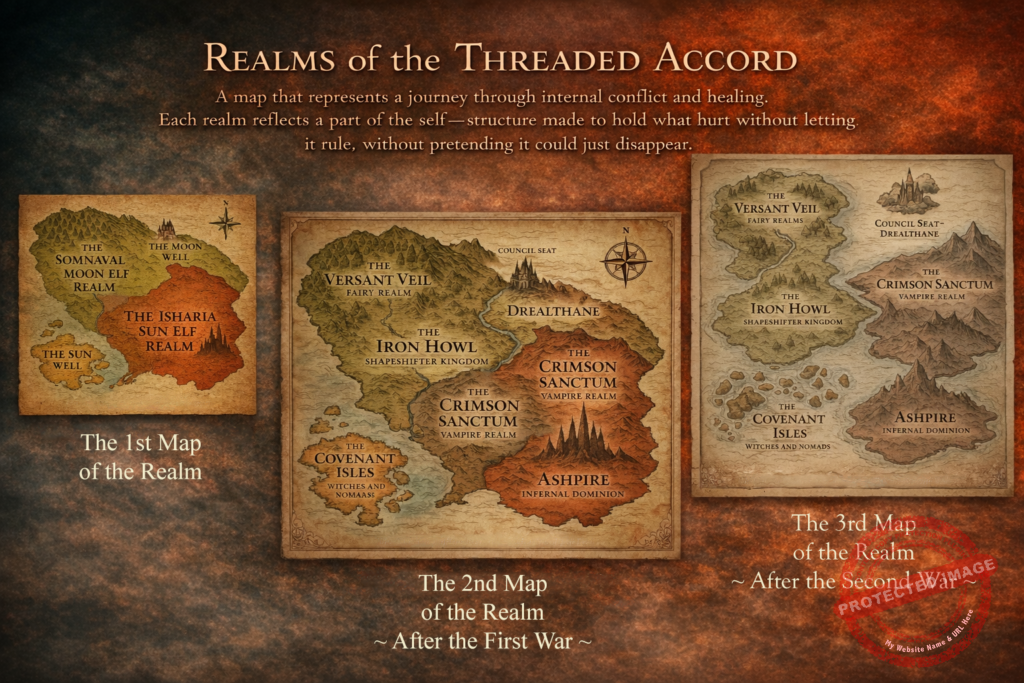
    At first, I didn’t understand what I was drawing. I only knew that I kept returning to the map, reshaping it as the story deepened. Only later did I realize that these weren’t revisions of a fantasy setting. They were stages of my own internal landscape.

    The first map is simple. Clear divisions. Sun and Moon. Fewer names. Fewer borders. It reflects a time before fracture, when I believed I could solve pain by choosing the “right” side of myself.

    That belief didn’t last.

    The second map expands because it has to. New regions emerge not as worldbuilding choices, but as necessities. Instinct, hunger, fire, and memory, parts of the self that could no longer be ignored, take form and demand territory. Everything exists at once. Overlapping. Unresolved.

    The system begins to form here, but it reacts rather than leads. It becomes necessary. It remains unstable.

    The third map, the one The Pact Reforged lives in, is not a healed world.

    It is a contained one.

    The System Wasn’t Control. It Was Containment.

    The realms no longer collapse into each other. They now have names, boundaries, and relationships held together by the Threaded Accord. Distance now exists where collapse once ruled, not because trust suddenly appeared, but because I could no longer assume it.

    Here, the system becomes deliberate.

    The realms, the rules, the trials, the laws of magic, none of them exist to control. They exist to contain. Each region holds a conflict I learned to face without letting it consume me: memory that wouldn’t soften, instinct that felt dangerous, hunger that carried shame, anger that wanted to burn everything down, balance that demanded sacrifice, and a fragile peace that survived only under watch.

    The map is not geography.
    Instead, it says: this pain belongs somewhere.

    In therapy, I learned that healing doesn’t mean resolution. It means relationship.

    Healing doesn’t mean erasing grief, it means giving it boundaries.
    It doesn’t silence fear; it gives it language.
    And it doesn’t destroy parts of yourself, it builds a system where they can exist without ruling everything.

    The Pact Reforged became an uneasy system of coexistence.

    An uneasy peace between parts of the self that once acted alone.

    When the Question Changed

    The Pact Reforged reflects the year when I stopped asking why am I like this? and started asking how do these parts interact, and what happens when they don’t? The trials aren’t punishments. They’re encounters. The rules aren’t restrictions. They’re agreements.

    This world didn’t come from imagination alone.
    It came from sitting with distress long enough to map it.

    The system feels deliberate because I had to make it deliberate.
    The peace remains fragile because I choose to watch it.

    And when the world feels like it’s holding its breath …

    So was I.

    Blog Categories*

    Behind the Scenes

    Personal Notes

    Explore the archive

    *This blog extends ideas from the novels, reflections, process writing, and lived experience behind the stories.
  • Four Ways of Surviving, One Way of Choosing Life

    What Threads of the Triad Means to Me

    When I look at the relationship between Aistriana, Kael, Aedric, and Vharon, I don’t see a romance structure.

    Seeing a Map, Not a Romance

    Instead, I see a map.

    This story did not begin as a plan. Instead, it began as a way to stay alive long enough to understand myself. Writing these characters was never about fantasy fulfillment. It focused on recognizing patterns, how I survived, how I protected myself, and how I learned, slowly, to stop living only in reaction to pain.

    Aistriana: Endurance

    Aistriana carries the center of that map.

    In this way, she represents the part of me that learned endurance early. She survived by becoming functional, responsible, capable. Similarly, I learned how to keep going even when grief stayed unresolved, even when silence felt safer than hope. She does not embody strength without cost. She forges strength because no other option remains.

    However, endurance alone is not living.

    Kael: Restraint

    At the same time, Kael exists where protection meets restraint. He embodies the part of me that learned how dangerous unchecked force can be, whether that force expresses itself as anger, desire, or intensity. In contrast, Kael is not about domination or control. He represents slow, painful understanding: power must learn when not to act. Staying present without hurting what you love requires skill, not instinct.

    Aedric: Memory

    Aedric carries memory.

    He is the part of me that remembers everything, every consequence, every loss, every choice that could not be undone. As a result, he exists in the tension between knowing and reliving, between truth and survival. Through him, I explored the fear of seeing truly, seen not as I pretended to be, but as I actually was beneath all the careful masks.

    Vharon: Refusal

    And then there is Vharon.

    Ultimately, Vharon is refusal.

    He represents the moment I learned that walking away can be an act of protection, not failure. Because of this, that refusing a path, even one you once shaped, can become the only way to avoid becoming something you never wanted to be. Vharon carries the fear that love, like power, might bind rather than free. And he carries the harder question: whether denying yourself connection is truly safer than risking transformation.

    Writing as Listening, Not Escape

    These four characters are not fragments of a single relationship.

    They are fragments of a process.

    Together, they form a system of balance I did not have at the beginning: endurance without self-erasure, strength without harm, memory without paralysis, refusal without isolation. Through this process, writing their connection allowed me to explore what a relationship could look like when it is not built on saving, fixing, or escaping, but on choice, presence, and responsibility.

    The triad bond is not about excess.

    It is about integration.

    Ultimately, it asks a simple but terrifying question:
    What happens when all the ways you learned to survive are asked to coexist, instead of competing?

    What Threads of the Triad Means to Me

    For me, then, the answer became the story.

    Not a promise of perfection.
    But a quiet return to life, one where connection does not erase pain, but makes room to carry it differently.

    That is what these characters mean to me.

    They are not who I was.
    They are how I learned to keep going.

    Blog Categories*

    Behind the Scenes

    Personal Notes

    Explore the archive

    *This blog extends ideas from the novels, reflections, process writing, and lived experience behind the stories.

  • How Photography Became My First Way Out

    When Straight Lines Became Too Tight

    There was a time in my life when everything moved in straight lines: accounting, software testing, deadlines, university courses in finance and banking. I was working in an IT company that built accounting software for PCs. As an assistant general manager I handled managerial accounting and tested the accounting software. On paper it all looked responsible, stable, “proper.”

    But something inside me kept tightening. Stress doesn’t announce itself politely. It builds quietly, until you no longer recognize the person you’ve become.

    Then came the moment that broke the illusion of straight lines.

    My best friend, died in a car accident. His fiancée survived, but she was left paralyzed. While I was asleep in the back seat of the car. I woke up into a world that no longer made sense.

    Grief did not arrive as something dramatic. It arrived as clarity. The kind that hurts because it cannot be ignored. I understood, with a certainty I had never known before, that stability alone is not meaning. That being “responsible” is not the same as being alive. That life can end or be permanently altered in a single, indifferent moment, and that waiting to live until everything feels safe is its own kind of disappearance.

    I didn’t know what I needed to do yet. I only knew that continuing as if nothing had happened was no longer possible. Something in me had already shifted. The lines were no longer straight, and I could not force them to be again.

    That realization did not save me. It didn’t fix anything. But it cracked something open, and through that crack, change eventually found its way in.

    The Moment a Camera Changed Everything

    Photography arrived in my life almost by accident.
    Art wasn’t what I was looking for. What I needed was air.

    I picked up a camera simply because I needed a place where numbers didn’t matter and logic could finally loosen its grip. Through the lens, the world slowed down just enough for me to breathe. Light became a companion. Shadows stopped being threats and turned into stories.

    Leaving the Expected Path Behind

    What started as a coping mechanism slowly reshaped my life.

    I made a difficult decision: I left my position in the IT company, and I stepped away from university during my third year of a four-year degree. People around me thought it was reckless. For me, it was survival.

    A Studio That Became a Sanctuary

    I began working alongside a photographer who created images for advertisements. That studio became my refuge. When the commercial work was done, I used the space to build my own portfolio: experimenting, learning, and rediscovering pieces of myself I didn’t even know I’d lost.

    Soon enough, photography stopped being just an escape and became something I could actually live from.

    When an Unexpected Door Opened Through Photography

    Later, everything evolved in a direction I didn’t expect.
    I became a coordinator for photographers shooting at music concerts. I searched for talent on DeviantArt, reached out to people whose work sparked something in me, and eventually built a small community around “beer meets”, casual gatherings where we shared ideas, explored locations, experimented in the studio, and helped each other grow.

    Many of the photographers I met back then eventually discovered the niche that defined their careers. Sometimes all someone needs is a door cracked open, a little guidance, and a space to explore freely.

    What This Chapter Taught Me

    Without realizing it, that chapter taught me something essential about myself: I love helping people find their creative direction, even when they don’t yet believe they have one.

    Photography didn’t just teach me composition or lighting. It taught me resilience. It showed me that creation is a form of healing, and that sometimes the only way to survive is to build something new from the inside out.

    Years later, writing would take over that role: deeper, quieter, but rooted in the same truth.

    You can surpass hardship when you find something that rebuilds you.

    For me, it began with images.
    Now it continues with stories.

    This is the first chapter of Personal Notes, the thread that connects who I was with who I’m becoming.

    JazzySegfault


    Blog Categories*

    Behind the Scenes

    Personal Notes

    Explore the archive

    *This blog extends ideas from the novels, reflections, process writing, and lived experience behind the stories.

  • Stubborn Cats in Charge •Test Post Supervised by Cats

    Stubborn cats say:
    No posts? I do what I want.

    This short test post exists to check site formatting, with feline oversight.

    It turns out these fluffy tyrants absolutely run this website, and honestly, I’m just here trying to keep up.
    If they want chaos, they get chaos.
    If they want naps… everything stops for the naps. There is no negotiation with creatures who believe gravity exists solely so they can push things off shelves.

    Stubborn Black and white cat supervising writing at the desk.

    Stubborn Cats in Charge

    This is a short test post used to verify that the site formatting and settings work correctly.
    Naturally, the feline supervisors insisted on overseeing every pixel, occasionally batting at the cursor, walking across the keyboard, and offering “feedback” in the form of dramatic staring.

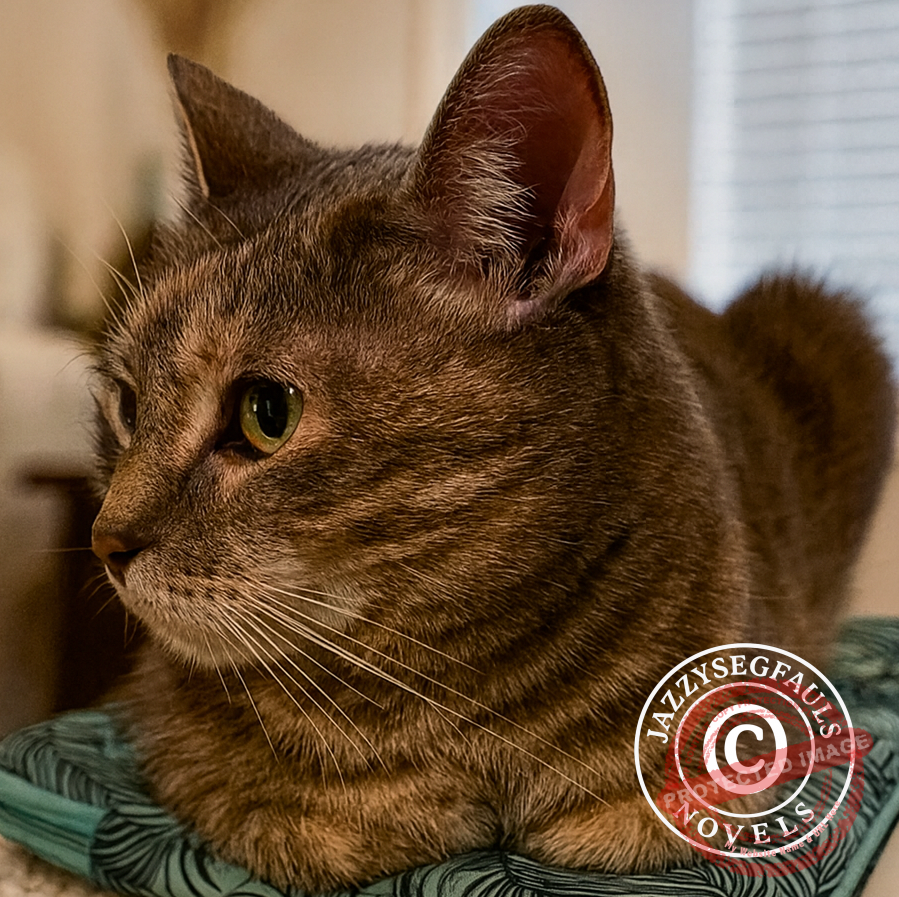
    Stubborn Brown Cat cat sitting like a supervisor on a cushion.

    Official Website Status Report (According to the Cats)

    If the site loads, they take credit.
    If it breaks, they deny involvement.
    If it works perfectly, they sit on the keyboard until it doesn’t.
    These furry desk overlords approve this message. Probably. They refuse to confirm.

    Official Cat Policies

    According to the current royal decree issued by the household’s whiskered leadership:

    • Every page must load instantly, unless someone is sitting on the router.
    • Keyboard ownership belongs to the cats; humans may borrow it during approved writing sessions.
    • All typos are considered their creative contributions.
    • If a post performs well, they claim responsibility.
    • If a post performs badly, they absolutely deny involvement.

    These policies are final. Attempting to change them requires petitioning a committee of two napping felines, which has a 0% approval rate.

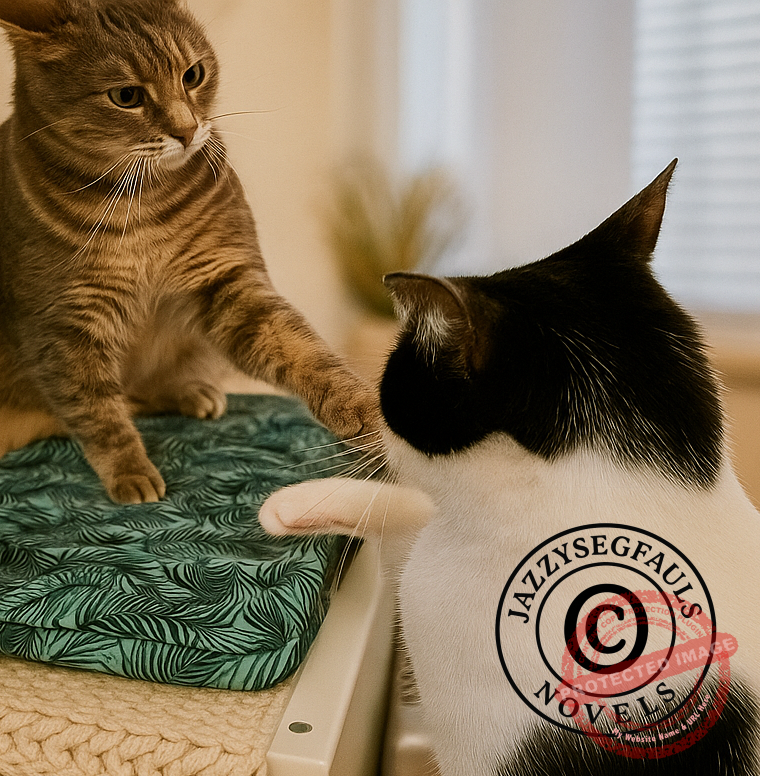
    Two stubborn cats establishing dominance during website operations.

    Additional Notes from the Feline Administration

    The cats recommend this “professional research source”:
    https://en.wikipedia.org/wiki/Cat

    If you’re curious about the fantasy worlds these creatures refuse to read, start here:
    https://jazzysegfaultnovels.com/books/

    And if you’d like to peek behind the scenes (unlike the cats, who simply don’t care), explore the first book here:
    https://jazzysegfaultnovels.com/on-the-first-book-and-the-three-who-walk-beside-her/

    The Stubborn Cats approve this blog post. Probably.

    Final Verdict from HQ (Headquarters of Quirkiness)

    The cats continue to monitor this website with great disinterest, approving and disapproving things without explanation.
    This test post exists purely because they demanded attention, and because sometimes, chaos needs documentation.

    Blog Categories*

    Behind the Scenes

    Personal Notes

    Explore the archive

    *This blog extends ideas from the novels, reflections, process writing, and lived experience behind the stories.