In 2023, I placed the final brick. I finished writing Book 5, it was like a closing of one life and the violent, beautiful birth of another.
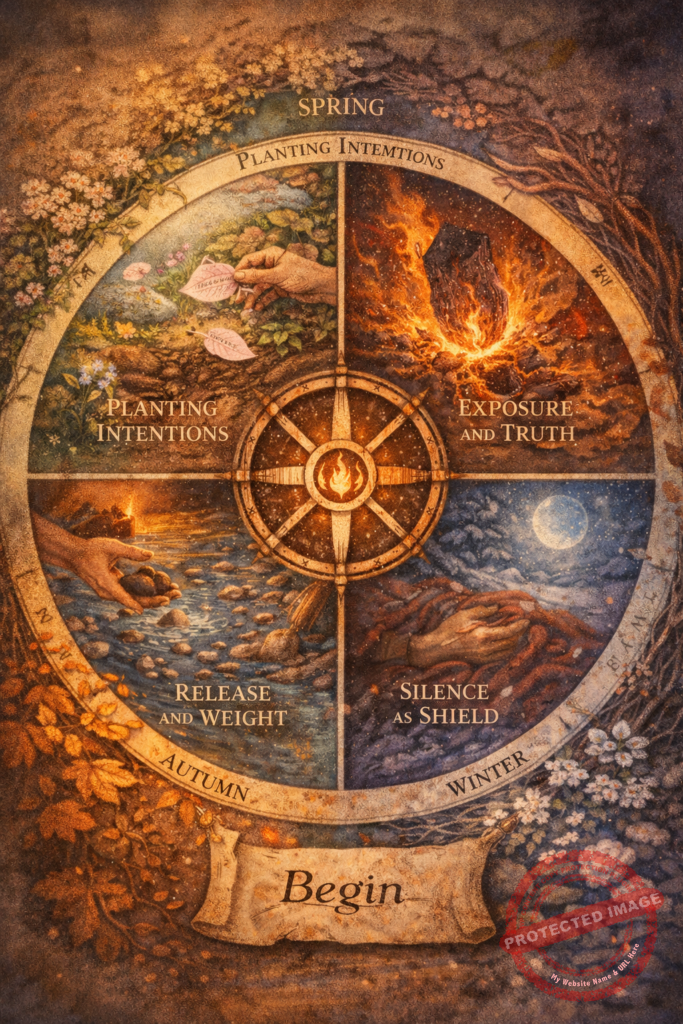
In the Realms I’ve built, seasons do not simply happen, they are celebrated through ritual. Each realm has its own way of negotiating the transition between what was and what will be. As I look back on my transition from accountant to psychologist, I realize I was performing these rites in my own blood and soul.
The Versant Veil: The Seedwake
For years, I was in a state of Binding Flame, crafting tokens of my life from the “dried plants” of my daily grind. But 2023 was my Seedwake. I took the ashes of my old career and mixed them into new soil. I planted three seeds: one for family(Kin), one for my writing (Craft), and one for my truth (Vow). I poured the first thaw-water over the threshold of my new practice, inviting the green of a new life to return.
Iron Howl: The Meltwater Run
My transition was not quiet, it was a Meltwater Run. I had to unearth the “den tokens” I buried in autumn, the parts of myself I hid to stay safe in the corporate world. I rinsed them in the cold reality of my burnout and ran toward the sunrise. As the ice of my 15 years sacrifice cracked, I let out a short howl. It wasn’t a cry of pain, but a call to the pack(Kin), signaling that the paths were finally open.
Crimson Sanctum: The Unwrapping Rite
During my “Stillness Tithe,” I wrapped my creativity in heavy cloth and hid it to protect my pride and my family’s stability. In the dusk of my burnout, I performed the Unwrapping Rite. I pricked my soul, the pain of the transition, and anointed my books. I chose which parts of my past to keep and which to “gift onward.” By releasing my old pride as a “provider,” I permitted myself the humility of action.
Ashpire: The Ember Unsealing
For fifteen years, my dreams were Flame-Sealed Oaths written on obsidian and locked in glass. I kept them above the hearth, visible but unreachable. In 2023, the heat of my collapse finally caused the glass to fissure. At dawn, I spoke my promises out loud and set them in motion. I now carry a shard of that broken glass as a charm, a reminder that a vow is only powerful when it is lived, not just kept.
The Covenant: The Thawing Knot
This is the heart of my current moment. I am untying the Thawing Knot beside the stream of my new life.
I have kept the strand of my story.
I have returned the strand of accounting to those who gave it to me.
I have set the strand of my exhaustion adrift.
As I stand at the edge of the water, having finished the five books that saved me, I speak the single word that the Covenant dictates for the start of the season:
The Price of the Final Brick: When the Body Speaks
After stepping away from photography and returning to accounting to support the family I chose, I believed I was building something stable. I traded the lens for ledgers, convinced that security was a fair exchange for inspiration. But building a home, even an internal one, is not a gentle process; it is a structural overhaul that leaves scars. In the final stretch of writing Book 5, I finally hit the wall. I learned the hard way that while the mind is a master at convincing you to keep going, the body always holds the veto power. And mine just cast its vote.
For 12 years, I lived a life of “shoulds.” I worked as an accountant, taking on the lowest-level, most exhausting projects just so I could work from home and be there for my two children. For 15 years, I prioritized the financial stability of my family over my own soul, believing that money was more important than my own calling. I was an exhausted builder, carrying bricks that weren’t mine to hold.
The pressure reached a breaking point in my final year of university. While still maintaining my 12 year accounting career, I attempted to pivot by working as a nurse. But my body began to protest almost immediately.
I was diagnosed with carpal tunnel syndrome, a physical manifestation of years of strain, forcing me to give up the IVF nurse role after only three months. I then worked as a nurse in a kindergarten for another three months (where I discovered my love for working with children, even if I was just taking care of scraped knees and ensuring the food met their dietary requirements), before quitting the nursing career for good. I kept pushing, oblivious to the fact that the collapse didn’t happen when I was doing nothing; it happened when I was doing everything.
While finishing my own thesis for Psychology, I wrote two other theses for colleagues to make ends meet. I did my own work so well, with so much heart, that I was the one accused of buying my thesis, the irony of life, because the work was “too good.” For two hours every night during five days, I had to defend my integrity in video conferences with my coordinator, proving that the words were mine. I was fighting for my truth while my body was preparing to surrender.
The Silence of the Fever
A week before the end, the rhythm stopped. I crashed into a burnout so severe that for seven days, I couldn’t eat. I had a high fever and was vomiting constantly, yet medical tests found no infection. There was no “germ” to fight, only the total exhaustion of a person who had spent fifteen years being a calculator instead of a human being.
For the next week, I lived on nectarines and water; it was all I could digest. Then, another two weeks were spent slowly relearning how to eat, how to exist, and how to recover.
“Burnout is not a lack of strength. It is the result of using strength to sustain a lie for too long.”
Because of this collapse, I missed the summer exam session to obtain my license as a psychologist, even though I had already finished the year’s exams. I missed the chance to enter the Clinical Psychology Master’s program that year. In the eyes of the world, I had “failed” a deadline. But in the eyes of my own soul, I had finally stopped building a house for others and started inhabiting my own.
From Numbers to Souls: The Final Transition
That burnout was the fire that forged my new life. It gave me the courage to do what fifteen years of “responsibility” had prevented: I quit accounting forever. I didn’t wait for things to be perfect. I took my license exam in the autumn, completed my pedagogical training in a concentrated burst, and started working as a psychologist with children who struggle with the same things I do: dyslexia, dysgraphia, and dyscalculia.
Between that exam and my eventual Master’s degree, I did the only thing that made sense: I wrote.
I wrote the books that were waiting in the shadows of my mind, even after finishing this five-book series. I found my reflection in the laughter of the children I helped and in the ink of the stories I mapped. I realized that my dyslexia wasn’t a broken gear in a machine; it was a different way of seeing the world. So, I kept writing until my soul stopped bleeding and I finally found where I belong.
The Rhythm of the Resident
Today, after 17 years of hard work, I don’t write from a place of exhaustion. I write from the hearth of the house I finally finished building.
Book 5 is the record of that transition. It’s the moment I stopped being a martyr for a career that stifled me and became a healer for myself and others. The “Final Brick” wasn’t just an achievement; it was the moment I allowed myself to rest and begin writing new stories.
The Covenant Isles say, “Begin.” And so, after fifteen years of counting other people’s wealth, I have finally begun to spend my own life.
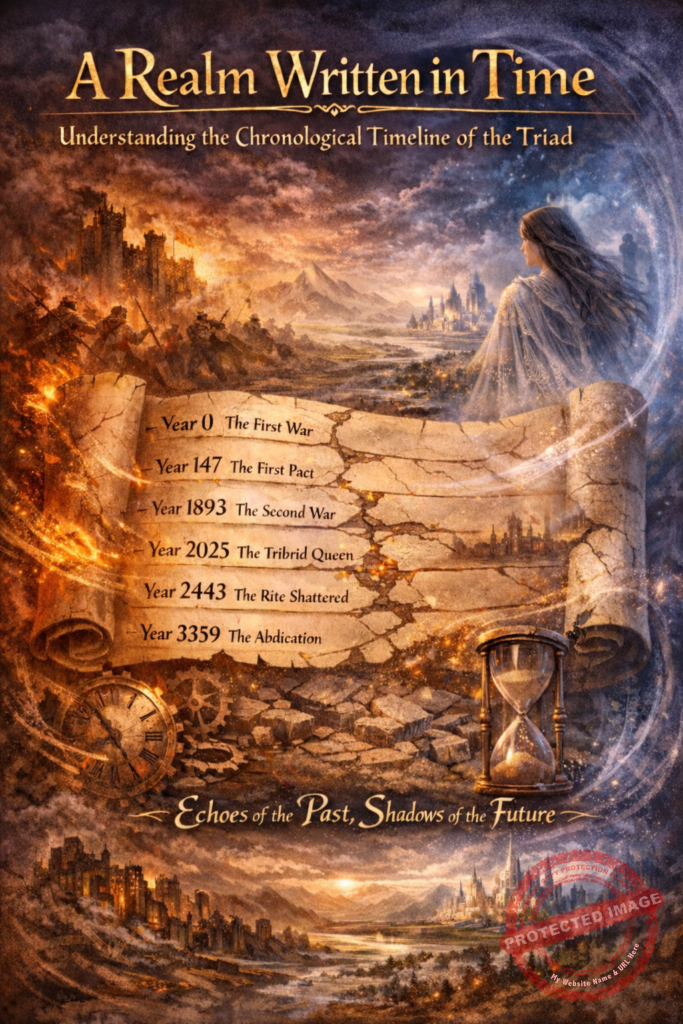
Understanding the Chronological Timeline of the Triad
Every world carries a memory. Mine carries a timeline.
The Chronological Timeline of the Realm is not just a list of dates. Instead, it acts as the backbone of the world behind Threads of the Triad. Each entry marks a choice, a fracture, or a failed attempt at unity. Together, these moments explain why the realm no longer trusts easy peace.
More importantly, they reveal why reckoning becomes inevitable in Book Four: Echoes of the Realm.
The First Fracture: War and Alliance
The story begins at Year 0, with the First War. At that moment, the realms divide, and ancient bloodlines fracture. Power scatters. Trust erodes. Although the war ends, the damage remains embedded in the world’s structure.
Later, in Year 147, the First Pact forms the realm’s earliest alliance. For a time, peace holds. However, it remains fragile because it relies on suppression rather than understanding. This pattern repeats often in the realm’s history.
Resistance and Control
By Year 1893, the Second War erupts. This time, the conflict centers on resistance to magical integration. Some realms fear loss of identity. Others fear imbalance. As a result, violence replaces dialogue.
Because war fails to resolve these tensions, the realm turns to governance. In Year 2023, the Council forms as a neutral authority meant to stabilize all realms. Although the intention sounds noble, neutrality soon becomes distance. The Council observes more than it intervenes.
The Tribrid Queens and the Cost of Unity
Hope rises again with the birth of Aelirya Sylveth in Year 2025, the First Tribrid Queen. Her existence represents something unprecedented: connection across all five realms. Naturally, fear follows hope.
By Year 2028, the Order of Sundering forms in secret. While it claims to protect balance, it actively opposes unification. This choice poisons what comes next.
In Year 2032, the Rite of Realignment is created. The ritual should unify the realms. Instead, corruption twists it into a tool of division. Therefore, when Aelirya is crowned in Year 2128, she rules a realm already undermined from within.
Her death during the sabotaged Rite in Year 2443 shatters the realm again. This moment matters deeply. It proves that forced unity always exacts a price.
Echoes Repeating Through Generations
History does not end with her death.
The birth of Aistriana Sylveth in Year 2611 echoes the past. Once again, the realm looks to a Tribrid Queen for salvation. Yet the scars of earlier failures remain.
By Year 3059, the Sylvareth Battle destabilizes entire regions. Power shifts. Borders strain. Memory resurfaces.
Finally, in Year 3359, Aistriana abdicates at the Council Summit. This act does not signal weakness. Instead, it marks refusal. She steps away from a broken structure rather than reinforcing it.
This is where Book One begins.
Why This Timeline Matters in Book Four
By the time Echoes of the Realm unfolds, the realm has repeated the same mistakes for over three thousand years. Every war, pact, ritual, and crown follows the same logic: control first, understanding later.
Book Four disrupts that cycle.
Instead of adding another event to the timeline, it asks why the timeline exists at all. It forces the realm to listen to what it tried to bury. Consequently, the past no longer stays silent. It speaks through blood, ash, and memory.
Time as a Living Force
This timeline does not serve as background lore. It acts as a living force inside the story. Each date leaves an imprint on the land, the magic, and the people who inherit its consequences.
Ultimately, Echoes of the Realm is not about fixing history. It is about facing it without flinching.
Because a realm that refuses to remember will always fracture again.
Echoes of the Realm, Book Four of the Threads of the Triad fantasy series, belongs to the second kind.
This is the book I wrote during my fourth year of therapy, a time when I stopped chasing resolution and began learning how to listen. Not for comfort. Not for closure. But for truth.
This novel does not pursue victory. It listens.
It follows the quiet, often unsettling pull of memory, consequence, and unresolved truth. While the earlier books explored fracture, survival, and endurance, Book Four asks a more difficult question:
What happens when the past finally answers back?
A Realm That Remembers
From the First War to the abdication that opens Book One, the realm has never truly healed. Every pact, every crown, every attempt at unity layered silence over unfinished wounds.
That idea mirrors something I learned deeply in therapy: what is buried does not disappear, it waits.
By the time the story reaches Echoes of the Realm, those buried histories no longer remain dormant. They surface.
Not as exposition, not as explanation. But as reckoning.
Because in this world, memory behaves like fire. It warms when respected. It burns when ignored.
Writing A Realm That Remembers taught me that what I tried to silence was never gone, only waiting to be seen. By facing memory instead of burying it, I found not closure, but clarity; and the strength to carry my past without being ruled by it.
Convergence Without Comfort
What once fractured now converges, but not into peace.
Old bloodlines, forgotten rituals, and suppressed voices tighten into the same flame. The characters are no longer able to choose whether to face the past. They must choose how.
Some resist. Others break. A few learn to stand inside the burn.
Meanwhile, the realm itself responds. Leylines shift. Ancient wells stir. Cities descend from the sky. The world reacts because it has always been listening.
That responsiveness: of systems, bodies, worlds; was something I understood viscerally while writing this book. Healing is not linear. It is reactive. And it is never neutral.
Why Book Four Changes Everything
This installment is a turning point in the Threads of the Triad series.
Not because the danger grows louder, but because the truths grow sharper.
Here, power stops looking like domination and starts resembling accountability. Leadership no longer means control. It means witness.
More importantly, Echoes of the Realm reframes healing itself. It does not promise wholeness. It offers honesty.
Because some truths do not heal. They burn.
And yet, the characters step toward them anyway. As I once did.
Core Themes in Echoes of the Realm
Reckoning instead of redemption
Memory as an active force
Connection over conquest
Legacy without erasure
Love as recognition, not possession
Echoes of the Realm is shaped by reckoning rather than redemption, where memory acts, connection outweighs conquest, and legacy is preserved without erasure. In the end, the story asks what it truly means to rebuild, not from ashes, but from what survived the fire; and now, it speaks.
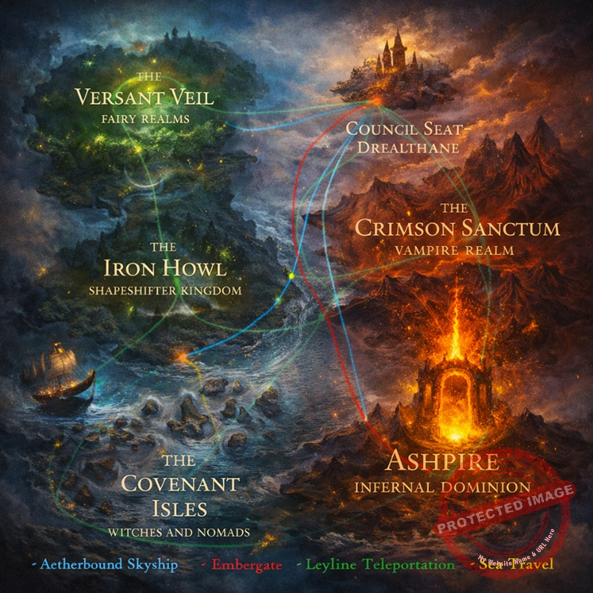
There are no open leylines between sea and sky. No sigils that cut distance down to intention. No sanctioned shortcuts that bypass the water entirely.
To reach the Isles, you sail.
You wait, you drift. You surrender to tides that do not care how ready you feel.
This is not technological limitation.
It is philosophy.
Refusing the Shortcut
In a world that has mastered instantaneous movement, the Covenant Isles choose delay.
One teleport nexus exists, and even that does not deliver you to the heart of the Isles. It brings you only to a hidden islet, a threshold. From there, passage continues by boat, across storm-patched waters that remember more than they reveal.
This refusal is intentional.
The Isles understand that instant access changes the nature of what is reached. That arriving too quickly often bypasses the inner work required to be there at all.
Not everything wants to be optimized.
The Tide Remembers
Sea travel in this world is shaped by tidecallers and moon-sailed vessels, not to control the water, but to listen to it. The sea is treated not as an obstacle, but as a keeper of memory.
You don’t dominate it, you don’t rush it. You adjust.
This resonated deeply with how I learned to live with dyslexia, not as something to be bypassed or “fixed,” but as a rhythm to work with.
I stopped asking how to move faster. I started asking how to move truer.
Arrival Is Not a Demand
Sea travel requires effort.
Physical presence. Endurance. A willingness to be uncomfortable without demanding clarity immediately. You don’t arrive pristine. You arrive altered: salt-stung, wind-worn, quieter than when you left. And that is the point.
Some places are not meant to be entered cleanly. Some truths do not open to speed. Some systems of balance collapse when approached with efficiency instead of patience.
The Covenant Isles accept travelers only after they’ve proven they can endure the in-between.
Allowing Mystery to Remain
The Isles are deliberately opaque.
They refuse full translation. Refuse full access. Refuse the illusion that everything must be explained, named, optimized, or rendered usable.
I learned that this, too, was a form of care.
Not every part of the self needs to be decoded, not every process needs to be streamlined or not every difference needs to be resolved into something smoother.
Some parts are allowed to remain as they are.
Choosing Presence Over Control
Sea travel is not passive. It is participatory surrender.
You show up, you adjust your sails and you wait when the water tells you to wait.
This is the final lesson of Book Three’s movement arc: that balance is not achieved by mastery, but by attention.
You do not conquer the tide. You learn its language.
Where the Long Way Leads
Not every destination wants efficiency. Some want presence.
The Covenant Isles exist because there are places, within worlds and within selves, that cannot be rushed without being harmed.
Choosing the long way is not weakness. It is respect.
And sometimes, it is the only way to arrive without losing what you came to protect.
After the Demon War, its leylines were severed, not as punishment, but as a recognition of reality. Too much power had moved too freely. Too much damage had passed through unseen corridors. Reopening those paths without restraint would not have restored balance.
It would have repeated the rupture.
So Ashspire returned differently.
One Gate, Not Many
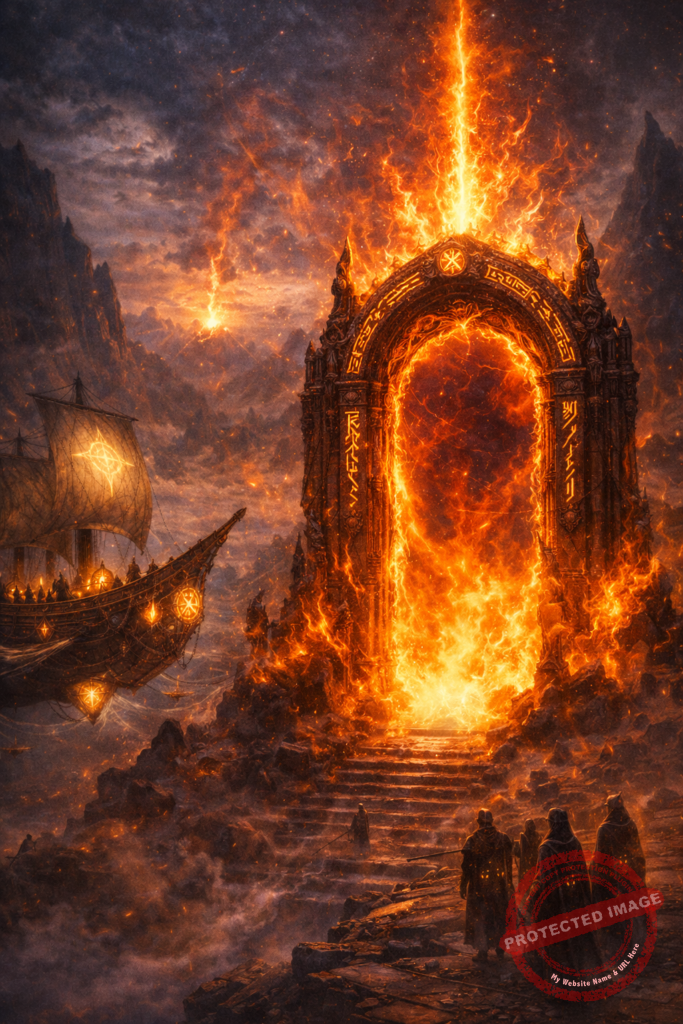
The Embergate is the only sanctioned point of entry into Ashspire.
Not hidden. Not secret. Not flexible.
Every passage goes through the same place. Every arrival is witnessed. Every departure leaves a record.
This is not efficiency. It is accountability.
When devastation has already occurred, openness is no longer optional. You don’t scatter entrances. You don’t allow quiet movement. You choose a single threshold and you make it visible enough that no one can pretend not to see what passes through it.
Fire That Does Not Hide
The Embergate does not open silently.
When activated, it sends a flare across the Aether, a signal visible to all major skyports and permanently recorded in the Council’s Observatory. The flare includes who activated it, who passed through, and why.
Fire, here, is not destructive. It is declarative.
This is fire that says: I am here. I am moving. I am accountable for the consequences.
Returning Is Not the Same as Being Forgiven
Ashspire was allowed to reintegrate, but not unchecked.
Only one skyship may dock. Only one gate may open. Every action is logged.
This is not trust restored. It is trust rebuilt slowly.
I understood this kind of return outside of fiction as well.
Returning to systems after burnout, trauma, or deep rupture doesn’t happen through declarations of wellness. It happens through supervision. Documentation. Ethical oversight. Through agreeing to be seen again before being believed again.
That process can feel humiliating if you mistake visibility for judgment.
But visibility can also be protective.
When Oversight Is a Gift
Supervision exists not because you are untrustworthy, but because the cost of failure is too high to carry alone.
In clinical work. In education. In caregiving roles.
I learned that accountability does not mean erasing your capacity for harm. It means acknowledging it, and building structures that prevent it from going unchecked.
Ashspire doesn’t deny its fire.
It contains it.
Choosing to Be Seen
The Embergate represents a moment most systems struggle with: allowing someone who has caused damage, or been damaged, to re-enter without pretending nothing happened.
It requires restraint from both sides.
From the one returning, it requires humility. From the system, it requires courage.
Because monitoring is not the same as control. It is a shared agreement that safety matters more than pride.
What the Fire Taught Me
I didn’t stop being dangerous. I learned to be accountable.
This form of movement is not freedom in the romantic sense. It is freedom that accepts consequence. Freedom that agrees to be logged, reviewed, questioned.
Ashspire does not ask to be trusted blindly.
It asks to be watched.
And sometimes, that is the most honest form of reintegration there is.
They don’t cut through space the way sigils do, nor do they slip unseen through the bones of the world like leylines. They move deliberately, visibly, their passage marked against the sky for anyone to witness.
That slowness is not a flaw. It is the point.
Movement That Can Be Seen
Skyships exist for journeys that cannot be hidden.
They carry diplomats, supplies, emissaries, decisions that affect more than one realm. Their routes are known. Their arrivals anticipated. Their departures recorded.
Unlike sigil travel, there is no privacy here. Unlike leylines, there is no illusion of neutrality.
When a skyship moves, the world notices.
That mirrors the shift that happened for me during the period when Book Three was written. Survival had taught me how to move quietly, efficiently, without drawing attention. Responsibility demanded something else entirely.
It demanded presence.
Stability Over Speed
Skyships are slow because they are stable.
They don’t rely on perfect clarity or institutional permission alone. They rely on trained navigators who read currents of aether: shifting, invisible forces layered between the physical and the magical realms. These navigators don’t chart fixed destinations so much as they track conditions: pressure, resonance, turbulence.
They accept that the path may change mid-journey.
That tolerance for uncertainty is not accidental. It’s learned.
Long-term change doesn’t happen in straight lines. It happens through adjustment, recalibration, and the willingness to continue even when certainty dissolves.
That was the kind of movement I was learning then.
Accountability Changes the Shape of Motion
Only Drealthane, the Council Seat, can deploy skyships with binding diplomatic seals.
They don’t grant speed. They grant accountability. A skyship doesn’t move because someone wants to go somewhere. It moves because a collective decision has been made, and recorded, that the journey carries consequence.
This reflected my own transition out of purely personal work.
Nursing. Psychology. Staying longer in pediatric wards. These weren’t solitary paths. They were forms of movement that carried others with them: patients, families, systems that don’t pause when you’re tired or unsure.
You don’t get to disappear inside that kind of work.
You are visible. You are responsible. And you are still learning as you go.
Carrying Others While Still Balancing Yourself
Skyships require crews.
No single mage steers them alone. There are checks. Shared labor. Roles that exist specifically to prevent one person’s error from becoming everyone’s catastrophe.
For a long time, I believed I had to be fully healed, fully stable, fully certain before I was allowed to carry responsibility for others. Skyships reject that idea. They are not piloted by perfection.
They are piloted by coordination.
You learn balance while moving. You learn responsibility while holding weight. You learn direction by staying present to the currents instead of forcing a straight line.
Why This Kind of Movement Matters
Aetherbound skyships mark the point where movement stops being only about survival and starts being about stewardship.
They are used for diplomacy, trade, rebuilding, slow work that doesn’t produce dramatic moments but changes the world over time.
This is where Book Three widens its lens.
The story is no longer only about whether the characters can move. It’s about whether they can be trusted to carry others while they do.
Where the Skyships Lead
Some journeys are slow because they are not meant to be taken alone.
Skyships taught me that progress doesn’t have to be quiet to be careful, and that visibility isn’t the same as exposure when accountability exists.
They move not because the way is clear, but because standing still would mean abandoning those already on board.
And once you accept that, slowness stops feeling like delay.
It doesn’t respond to individual will or clarity alone. It runs through the bones of the world, ancient currents of power laid down long before any one person learned how to move.
You don’t draw a leyline, own it or activate it just because you want to go somewhere.
You are allowed access, or you aren’t.
Who Gets to Decide
Leylines are guarded by leykeepers.
They don’t rule kingdoms, but they decide who is recognized by the system as legitimate. They hold the activation rites, the permissions, the sigils that open paths most people will never see.
This is not portrayed as cruelty in the world of the Threaded Accord.
It is portrayed as responsibility.
Because leylines don’t just move people. They move consequence.
In Book Three, only council-authorized carriers and powerful mages are permitted to use them. Not because others are unworthy, but because uncontrolled access has already proven catastrophic.
Ashspire learned that lesson the hard way.
When Isolation Is Protective
After the Demon War, Ashspire’s leylines were sealed.
From the outside, it looks like punishment. Exile. Suspicion carved into the world itself. But within the system, it is a defensive act, a recognition that when harm has passed through a place unchecked, immediate reconnection can be more dangerous than separation.
Isolation, in this context, is not abandonment. It is containment after damage.
There are times when a system must say: Not yet, not this way and not without oversight.
I learned that truth outside of fiction as well.
Approval Is Not Always Personal
Academic systems, professional training, clinical pathways, they all function like leylines. They require validation. Documentation. Assessment. Approval.
Support does not always arrive when you need it. It arrives when the system decides it is safe to give it.
That delay can feel brutal. Especially when you’re already doing the work.
But forcing access before safety exists doesn’t create healing. It creates collapse.
I saw this in hospitals, in training and I saw it in myself.
Wanting to help faster does not mean you are ready to carry the weight that comes with it. Wanting understanding does not automatically grant access to every system designed to hold it.
Sometimes, being told to wait is what prevents harm, to others, and to yourself.
The Choice to Restrict
The Covenant Isles take this further.
They do not allow open leyline travel at all. One nexus. One controlled point of arrival. Everything else must be reached by sea.
This is not fear. It is deliberate cultural boundary.
The Isles understand that instant access erodes meaning. That some knowledge, some balance, some ways of living only survive when they are not immediately reachable. Their restriction is not about power.
It is about preservation.
That distinction reshaped how I understood limits.
Not all closed doors are rejection. Some are refusal to be consumed.
Systems Are Not Neutral, But Neither Are They Evil
Leyline teleportation forces a hard truth: systems will always exist. They will always decide who moves freely and who waits. Pretending otherwise doesn’t dismantle them, it just leaves you unprepared for their weight.
The question is not whether systems have power. The question is how they use it.
And how you learn to move within them without erasing yourself.
What the Leylines Taught Me
Not all blocked paths are punishments. Some are boundaries that kept me alive.
This part of the journey taught me patience without passivity. Respect without submission. And the difference between readiness and entitlement.
Sigils taught me how to choose. Leylines taught me when choice must wait.
Sigil Teleportation Movement That Requires Consent
Sigil teleportation is the most personal form of movement in the realms.
It doesn’t rely on shared roads or sanctioned pathways, or draws power from the world at large. It draws it from the individual who activates it.
As a result, a sigil only works when the traveler knows exactly where they are going.
Not approximately. Not emotionally. Precisely.
That requirement is not a technical limitation. It is a philosophical one.
Naming Before Moving
In therapy, I learned something deceptively simple: you cannot move toward what you cannot name.
Sigil teleportation requires a clear mental image of the destination. Recent memory. A mapped place. A magically imprinted anchor. If the image is vague, the result is not partial success, it is displacement. Arrival miles away from where you intended to be.
In other words, that mirrors internal work more closely than I was comfortable admitting at the time.
Before my diagnosis, I had learned to compensate without understanding what I was compensating for. As a result, I moved constantly: adapting, adjusting, enduring, but without a clear internal map. On the surface, progress happened, but it was exhausting and imprecise. Eventually, I arrived places emotionally that didn’t fit, then blamed myself for feeling wrong there.
The diagnosis of dyslexia didn’t give me a destination. It gave me coordinates.
It was a sigil.
Instead, it was not a label meant to define me, but a symbol that allowed me to finally visualize where I actually was, and therefore where movement might land me safely.
Consent Is Not Optional
In the world of the Threaded Accord, sigils can be inscribed on talismans, rings, and in rare cases, burned into skin. However, never without consent.
A sigil tied to a person’s essence cannot be forced. If it is, it fails. Or worse, it fractures the traveler.
For a long time, I treated my own body and mind as something to be overridden in the name of function. If I could endure it, I assumed I should. If I could push through, I did. Even then, consent, real consent, was something I offered others far more readily than myself.
Sigil magic rejects that logic.
You do not move unless you agree to move. You do not arrive unless you allow yourself to arrive.
Reclaiming authorship over my own process: how I learn, how I think, how I move through systems not built for me; was the first form of teleportation that didn’t cost me something essential.
Precision Over Speed
Sigil teleportation is fast. Instant, even.
But speed is not its defining feature. Precision is.
The magic does not reward urgency. It rewards clarity.
In early healing, movement is often solitary. Not because others are unwelcome, but because internal alignment must happen before shared motion becomes possible. Sigil travel reflects that reality: it allows solo or very limited group travel, only when there is contact, consent, and shared intent.
Most early work is done alone.
That isn’t isolation. It’s calibration.
Learning that clarity matters more than speed changed how I approached everything: education, therapy, caregiving, even ambition. I stopped asking How fast can I get there? and started asking Is this actually where I mean to land?
Arrival Matters
Misaligned sigils don’t fail dramatically. They fail quietly.
You arrive. Just not where you thought you were going.
That, too, is familiar.
Misunderstood needs, unnamed limits, borrowed expectations, they don’t stop movement. They distort it. You still progress and still function. But something always feels slightly wrong, slightly off-center, slightly unsafe.
Sigil teleportation teaches a harder lesson than endurance ever did:
Movement without clarity is not freedom. It is displacement.
Where This Path Leads
Sigil travel is not escape. It is choosing exactly where you are allowed to land.
In Book Three, this is the first form of transportation because it mirrors the first internal shift I had to make: learning that movement begins with permission, and that permission starts with naming.
Before roads, gates and shared systems.
First, you touch the sigil. And you decide where you are willing to arrive.
There was a time when staying still felt like survival.
In earlier books, I built rules. Borders. Systems. Characters. They weren’t there to control the world; they were there to hold it together. To keep parts of it from bleeding into one another until I could breathe again.
But Book Three exists because it stopped being enough.
This book was written in my third year of therapy, a year when naming things was no longer the hard part. By then, I had language. Insight. Awareness. What I didn’t yet have was movement that wasn’t driven by urgency or collapse.
I had learned how to endure. I had not yet learned how to choose.
When the Past Shifted Shape
The diagnosis of dyslexia didn’t fix anything. It reframed everything.
It happened quietly.
My psychologist had asked me to keep a journal. I did, but I wrote stories instead.
Two books, written as narrative because that was the only way my thoughts would hold together without fragmenting. I brought them into therapy not as literature, but as evidence, a way of showing what I couldn’t explain directly.
She read them carefully.
Not for plot. For structure.
And then she said something that stopped time for a moment: “You know this reads like someone who has been compensating their entire life.”
The diagnosis didn’t arrive as a revelation. It arrived as recognition.
The Cost of Constant Translation
Suddenly, the effort made sense. Not effort as discipline or ambition, but effort as constant translation. The invisible work of holding thoughts in place long enough to shape them. The vigilance required to keep meaning from slipping through cracks no one else seemed to notice.
The exhaustion, too, took form. Not the kind that comes from doing too much, but from doing everything twice: once to understand it internally, and once again to make it legible to the world. The way staying in place always felt like swimming upstream, not because I lacked strength, but because the current was never designed for how my mind moved.
Endurance had never felt neutral. It always carried a price.
From Moral Failure to Evidence
What I had mistaken for resilience was often compensation. What I had called discipline was frequently survival strategy. Overpreparing. Overchecking. Rereading until words blurred. Building systems around myself without realizing I was doing so, just to stay afloat in spaces that assumed ease where there was none.
Nothing about who I was changed. My capacity didn’t suddenly improve. I didn’t become “better” at anything.
But the past reorganized itself.
Moments I had filed away as personal failures loosened their grip. The chronic tension around tasks others found simple. The shame of needing more time, more structure, more silence. The instinct to endure quietly, even while asking careful, persistent questions to understand what I didn’t yet have language for.
They stopped being moral flaws. They became evidence.
Not of weakness, but of adaptation. Of a mind that had learned to move sideways when forward was blocked. Of a system built not for comfort, but for survival.
And once seen, it could no longer be unseen.
Containment Was No Longer Enough
By the time I was writing Book Three, containment had done its job.
In Book Two, containment was the work. Boundaries. Agreements. Rules that prevented collapse. A system where pain could exist without consuming everything. But containment has a limit.
There comes a point when the rules I built to survive begin to restrict my ability to grow. When staying within them requires more energy than moving beyond them. When endurance turns into erosion.
That was the year I was living in.
In my second year of nursing college, I made the decision to pursue psychology and enroll the following year.
During my clinical placements as a nurse in a children’s hospital, especially in orthopedics and surgery, I learned that pain does not wait for you to be ready. I often stayed beyond my required hours, unable to step back into my own life while children continued to suffer. Skill alone was never what I wanted to offer patients. What I wanted was to understand them.
That is why I enrolled in a psychology program. Understanding meant learning how to move toward people, not only away from my own limits, and I could no longer do that by staying still.
Movement, Not Escape
Transportation systems in this world are not conveniences. They are not shortcuts. Nor are they about running away. They exist because movement became necessary.
This book was written in a year where motion stopped being reactive. Where I learned that leaving a place: emotionally, cognitively, structurally, doesn’t mean abandoning it. It means acknowledging that what once protected you may no longer be safe.
Movement became intentional.
That’s why every form of transportation in this world has rules. Costs. Permissions. Limits. Witnesses.
Not because motion should be controlled, but because it should be chosen.
Why Transportation Exists at All
Rules taught me how to stay. Movement taught me how to choose.
I had built transportation systems when I accepted that not all growth happens in place, when I understood that endurance by itself is not a virtue, and when I realized that sometimes the most responsible thing you can do is admit that where you are: mentally, emotionally, structurally; is no longer safe.
These systems are not about speed. They are about agency.
Some paths require clarity before you can take them. Others require permission. Still others demand witnesses. Many take time. A few refuse to be rushed.
And some only open when you stop mistaking stillness for strength.
Setting the Journey
This series of posts is not just about how characters move between realms.
It’s about how I learned to move between parts of myself without erasing any of them.
Book Three begins when containment breaks its silence and asks a harder question: