Why the Map Came Before the Answer
This is why I built a world with rules, not to explain the story, but to survive writing it.
I created it to survive myself.
While writing The Pact Reforged, I entered my second year of therapy. By then, the obvious wounds already had names. I had language. I had insight. What I didn’t have yet was structure, a way to hold pain without drowning in it.
So I built one.
What Therapy Didn’t Give Me, At First
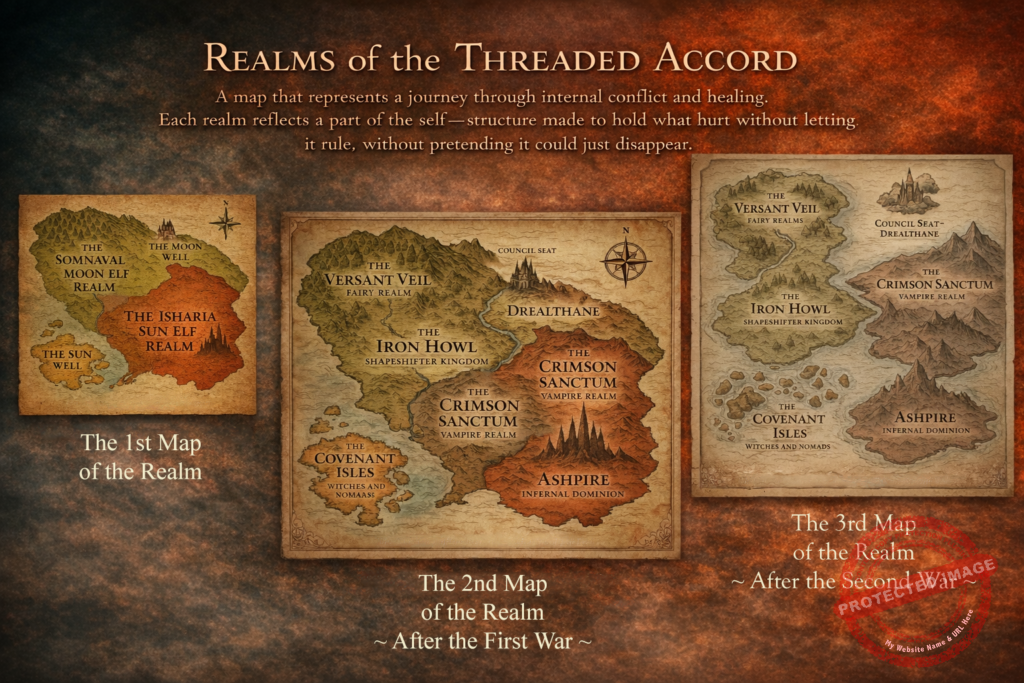
At first, I didn’t understand what I was drawing. I only knew that I kept returning to the map, reshaping it as the story deepened. Only later did I realize that these weren’t revisions of a fantasy setting. They were stages of my own internal landscape.
The first map is simple. Clear divisions. Sun and Moon. Fewer names. Fewer borders. It reflects a time before fracture, when I believed I could solve pain by choosing the “right” side of myself.
That belief didn’t last.
The second map expands because it has to. New regions emerge not as worldbuilding choices, but as necessities. Instinct, hunger, fire, and memory, parts of the self that could no longer be ignored, take form and demand territory. Everything exists at once. Overlapping. Unresolved.
The system begins to form here, but it reacts rather than leads. It becomes necessary. It remains unstable.
The third map, the one The Pact Reforged lives in, is not a healed world.
It is a contained one.
The System Wasn’t Control. It Was Containment.
The realms no longer collapse into each other. They now have names, boundaries, and relationships held together by the Threaded Accord. Distance now exists where collapse once ruled, not because trust suddenly appeared, but because I could no longer assume it.
Here, the system becomes deliberate.
The realms, the rules, the trials, the laws of magic, none of them exist to control. They exist to contain. Each region holds a conflict I learned to face without letting it consume me: memory that wouldn’t soften, instinct that felt dangerous, hunger that carried shame, anger that wanted to burn everything down, balance that demanded sacrifice, and a fragile peace that survived only under watch.
The map is not geography.
Instead, it says: this pain belongs somewhere.
In therapy, I learned that healing doesn’t mean resolution. It means relationship.
Healing doesn’t mean erasing grief, it means giving it boundaries.
It doesn’t silence fear; it gives it language.
And it doesn’t destroy parts of yourself, it builds a system where they can exist without ruling everything.
The Pact Reforged became an uneasy system of coexistence.
An uneasy peace between parts of the self that once acted alone.
When the Question Changed
The Pact Reforged reflects the year when I stopped asking why am I like this? and started asking how do these parts interact, and what happens when they don’t? The trials aren’t punishments. They’re encounters. The rules aren’t restrictions. They’re agreements.
This world didn’t come from imagination alone.
It came from sitting with distress long enough to map it.
The system feels deliberate because I had to make it deliberate.
The peace remains fragile because I choose to watch it.
And when the world feels like it’s holding its breath …
So was I.
Blog Categories*
*This blog extends ideas from the novels, reflections, process writing, and lived experience behind the stories.
Leave a Reply